How to Choose AI Autoblogging Tools for Scheduled Publishing: A Buyer's Guide
You can generate 100 articles in an afternoon and still publish nothing. The bottleneck is not writing, it is scheduling: deciding what goes live on Tuesday at 9am, then making WordPress actually do it. Most tools stop at the draft.
This buyer's guide shows you how to filter autoblogging platforms by scheduled publishing first, then compare modes, bulk output, credits, and content controls. You will finish knowing which tool fits your posting cadence, and whether Autoblogging.ai is the right one for your blog or agency.
What Is Autoblogging.ai? A Buyer's Guide to the Platform Behind the Tool
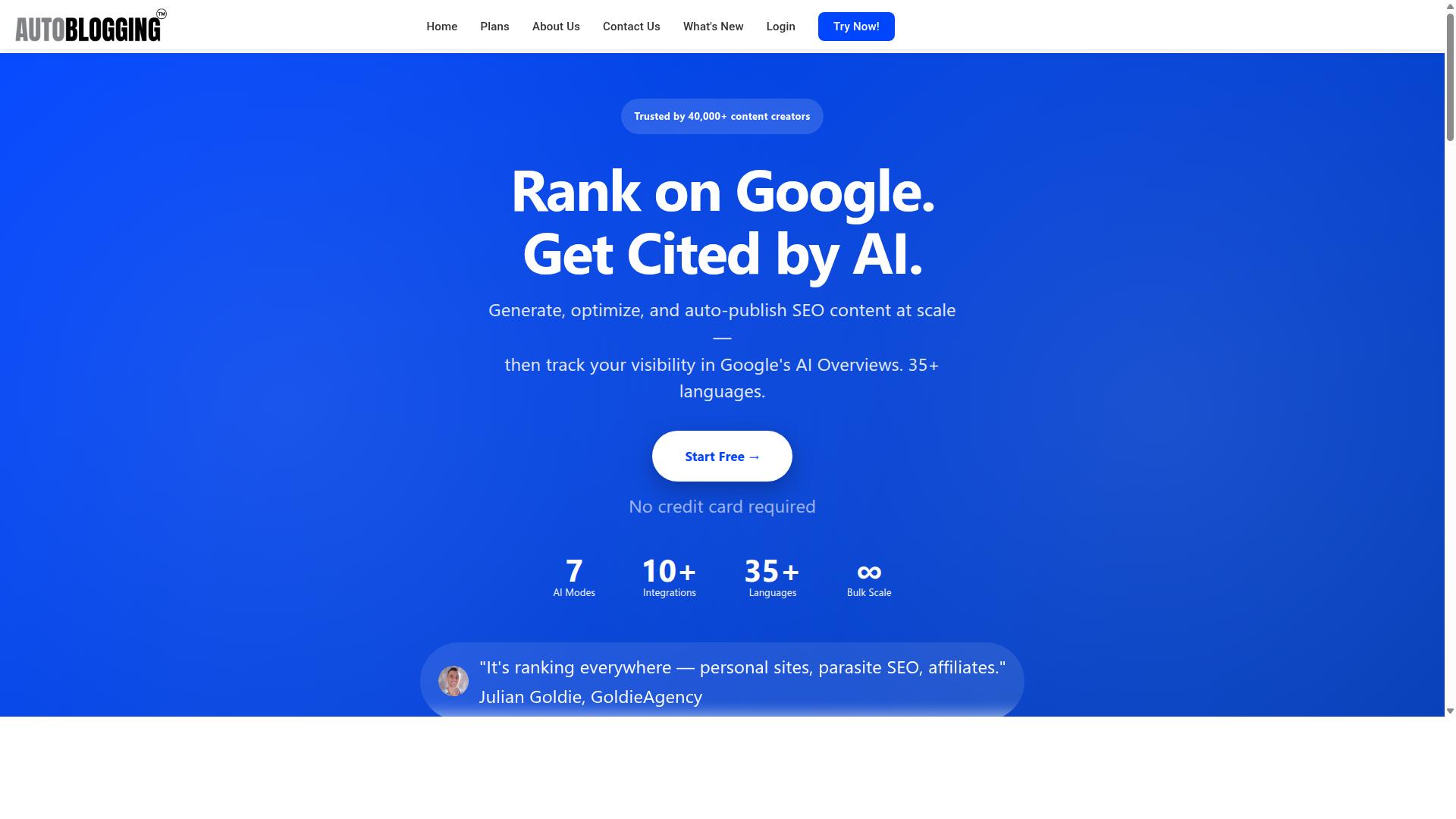
Autoblogging.ai is a cloud-based SaaS platform that uses artificial intelligence to generate and publish blog content automatically, designed to streamline content workflows for bloggers, agencies, and affiliate marketers.
The product is developed by Digimetriq.com, a company whose stated mission is to help bloggers, website owners, and agencies save time and improve their online presence through cutting-edge technology. That mission shapes how the platform is positioned in the market.
Rather than replacing every step of the writing process, Autoblogging.ai is designed to cut down content costs and enable human counterparts within standard operating procedures by delivering a solid first draft. Digimetriq's longer-term aim is to replace human counterparts entirely, which signals where the roadmap is headed.
Because it runs online, the tool is available to users worldwide. There is nothing to install on a local machine, and no geographic restriction limits who can sign up and start generating articles.
Its core capability is straightforward: producing articles through AI. For anyone weighing AI autoblogging tools for scheduled publishing, that is the foundation to understand before evaluating the finer points of workflow automation, editorial calendars, and publishing frequency. The rest of this buyer's guide builds on that base, covering what to check, what to compare, and where a platform like this one fits into a content pipeline.
Who Autoblogging.ai Serves: Bloggers, Agencies, and Affiliate Marketers
Autoblogging.ai is built for a diverse set of content creators, including individual bloggers, marketing agencies, SEO professionals, and affiliate marketers who need to produce high volumes of content efficiently.
The platform's audience breaks down into several distinct groups, each with different reasons for adopting content automation:
- Bloggers and website owners running personal sites who want to keep a steady publishing schedule without writing every post from scratch
- Marketing agencies managing content across multiple client websites, where volume and consistency matter as much as quality
- Affiliate marketers operating niche affiliate sites that depend on regular fresh content to attract and retain search traffic
- SEO professionals working on parasite SEO, portfolio sites, and local sites, where content output feeds directly into ranking strategies
- Content creators who need a first draft fast and prefer to spend their time editing and refining rather than starting from a blank page
What ties these groups together is the same underlying problem: producing enough content to stay competitive online, without letting costs or hours spiral. A tool that generates articles through AI addresses that problem directly.
For agencies in particular, the appeal is scale. Managing client websites means juggling different tones, topics, and publishing calendars, so any platform that shortens the path from idea to draft has real operational value. Affiliate marketers face a similar math, since niche sites live or die on content volume and publishing frequency.
Bloggers and SEO professionals benefit in a different way. They often work alone, so saving time on drafting frees them to focus on strategy, keyword research, and SEO optimization instead of typing every paragraph themselves.
This range of users also explains why Autoblogging.ai is positioned as a global, online tool rather than a niche utility. The needs differ from segment to segment, but the core value, faster content production at lower cost, stays consistent across all of them.
Why Scheduled Publishing Should Be Your First Filter When Choosing a Tool
When evaluating AI autoblogging tools, scheduled publishing is often the most critical factor because it determines whether you can maintain a consistent content pipeline without manual intervention. A tool that generates brilliant articles but forces you to upload each one by hand is only half a solution. The automation promise breaks at the exact moment a human has to log in and hit publish.
Scheduled publishing transforms content generation into true content automation. You define your publishing frequency, set an editorial calendar, and let the software handle distribution on its own. That consistency matters for SEO optimization because search engines reward sites that publish steadily rather than in unpredictable bursts.
Audience engagement follows the same pattern. Readers return when they know fresh material appears on a reliable schedule, whether that is daily, weekly, or several times per week. Without scheduling, even a strong library of generated articles sits idle until someone finds the time to post it.
Time management is the third pillar. Manual uploads consume hours that could go into keyword research, strategy, or reviewing output quality. Buyers who want genuine workflow automation should treat scheduled publishing as a non-negotiable filter, not a nice-to-have feature.
The Criteria That Actually Matter: Modes, Bulk Output, and Publishing Workflow
The criteria that separate a robust autoblogging tool from a basic one are the variety of AI generation modes, the ability to produce content in bulk, and a seamless publishing workflow that integrates with your CMS. Each criterion deserves careful scrutiny before you commit to any platform.
Number of AI modes. Look for a tool that offers both quick and advanced generation options. A quick mode suits short news-style posts or simple listicles, while an advanced mode should give you more control over length, structure, and tone of voice. Some platforms also separate modes for article rewriting or content spinning, which helps when you want to refresh older posts.
Bulk generation capacity. If you plan to scale, check how many articles the tool can produce in a single run. A capacity of up to 500 articles per batch, for example, changes what is realistic for a growing site. Bulk output matters most when paired with queue management, so generated drafts flow into a calendar instead of piling up.
Publishing workflow. This is where scheduling lives. Evaluate these elements:
- WordPress plugin or native CMS compatibility for direct posting
- Scheduling controls tied to an editorial calendar
- API access for custom integrations and multi-site setups
- RSS feed import for pulling in source material
- Image sourcing and featured image automation
- Internal linking and external linking handled automatically
- Meta description, title tag, and slug optimization
Also consider quality controls that support the workflow: a plagiarism checker, readability score reporting, multilingual support, and brand voice settings. These features determine whether bulk output stays publishable at scale. A tool with strong natural language generation but weak CMS compatibility will still leave you copying and pasting, which defeats the purpose of content automation. Buyers should weigh generation power and publishing workflow together, because a gap in either one creates a bottleneck the other cannot fix.
How Autoblogging.ai Answers the Scheduled Publishing Buyer's Checklist
Autoblogging.ai directly addresses the scheduled publishing checklist with features designed to automate the entire content pipeline from generation to publication. Instead of juggling separate tools for writing, editing, and posting, users work inside one platform that covers generation, optimization, and distribution.
The platform combines several capabilities that buyers typically evaluate one by one: bulk article generation, a WordPress plugin with scheduled auto-posting, and quality controls such as Godlike Mode and a Human Proofreader. It also connects to Web 2.0 platforms like Medium, Dev.to, Hashnode, Telegraph, and Tumblr, plus multi-platform publishing for Shopify, Wix, Webflow, Blogger, and Ghost.
For teams that need more than software, Done For You packages are available. And for developers or advanced users, API access, Zapier, and n8n support make it possible to slot content automation into an existing workflow rather than replacing it.
The subsections below break down the two areas buyers ask about most: generating at scale and keeping quality high once volume increases.
Bulk Generation and One-Click WordPress Publish at Scale
Autoblogging.ai enables users to generate up to 500 articles in a single batch and publish them directly to WordPress with a one-click integration. The bulk workflow runs through a CSV upload, so users can supply topics, keywords, or other inputs in a structured file rather than creating each article manually.
Publishing is handled through a dedicated WordPress plugin that supports unlimited sites. The integration allows for scheduled auto-posting, which means generated content does not have to go live the moment it is created. Instead, it can be queued and released according to a plan.
That scheduling capability matters for anyone building an editorial calendar. A steady publishing frequency tends to serve SEO better than irregular bursts, and automation makes consistency easier to maintain without daily manual effort.
For agencies and high-volume bloggers, the practical benefit is scalability. A single batch of up to 500 articles can feed weeks or months of scheduled output, freeing time that would otherwise go into drafting, formatting, and uploading posts one at a time.
Beyond WordPress, the same content can be distributed to Web 2.0 platforms and other CMS options like Shopify, Wix, Webflow, Blogger, and Ghost. That breadth helps publishers extend reach without rebuilding their process for each destination.
Content Quality Controls: Godlike Mode, SERP Analysis, and Human Proofreading
Autoblogging.ai incorporates advanced quality controls, including the Godlike Mode that performs SERP competitor analysis, LSI keyword extraction, and knowledge graph integration to produce highly optimized articles. In practice, this means the tool studies what already ranks before writing, then works relevant terms and related concepts into the draft.
That approach supports SEO optimization at the structural level, not just the surface. LSI keywords help content read naturally around a topic, while knowledge graph extraction encourages coverage of connected entities and subtopics that search engines associate with the subject.
For buyers comparing modes, the platform offers several paths:
- Quick Mode: free, with single and wizard options for fast drafts
- Godlike Mode: SERP analysis, LSI keywords, and knowledge graph extraction
- Bulk Generation: up to 500 articles via CSV
- News Mode: Google News integration for timely content
- Amazon Reviews Mode: for product-focused writing
Quality does not stop at generation. The AI Proofreader and Human Proofreader options give users a way to check accuracy and readability, which matters when publishing at volume. Additional tools like Semantic SEO Analysis, a 21-point audit, and the Snippet Optimizer help refine articles before they go live.
Together, these controls address the main worry buyers have about automated content: that speed will come at the cost of quality. By layering competitor research, keyword extraction, and proofreading into the pipeline, Autoblogging.ai keeps standards consistent even when hundreds of articles are moving through at once.
Key Features and What Makes Autoblogging.ai Stand Out
Autoblogging.ai distinguishes itself with a broad feature set that includes over 10 AI modes, support for 35+ languages, and more than 35 integrations with popular platforms and tools.
For anyone building a scheduled publishing workflow, that breadth matters more than any single feature. A content pipeline only runs smoothly when the tool can generate varied content, speak to different audiences, and connect to the systems already in your editorial calendar.
The platform is trusted by 40,000+ content creators and holds a 4.9 average rating, with 1M+ articles generated to date. Those numbers suggest the feature set holds up under real publishing volume, not just demo conditions.
Several capabilities directly support a hands-off content pipeline:
- One-click WordPress publish, which shortens the gap between generation and scheduled publishing
- SERP competitor analysis and semantic SEO tools for keyword research and SEO optimization
- A 21-point SEO audit and featured snippet optimization for post-generation quality checks
- A human proofreader included in all plans
- Credits rollover, so unused capacity is not lost between publishing cycles
- 24/7 support and new features shipped weekly
Each of these speaks to a different stage of the workflow, from natural language generation through to CMS compatibility and quality control. The next section breaks down the three headline numbers: AI modes, languages, and integrations.
10+ AI Modes, 35+ Languages, and 35+ Integrations
With more than 10 distinct AI modes, Autoblogging.ai allows users to tailor content generation for various needs, from quick drafts to in-depth, SEO-optimized articles. Modes named in the platform's feature set include Quick Mode, Godlike Mode, and Bulk Generation, each aimed at a different point on the speed-versus-depth spectrum.
That range gives buyers real flexibility. A publisher maintaining a high publishing frequency might lean on Bulk Generation to fill an editorial calendar, while a site chasing competitive rankings might prefer a deeper mode for cornerstone content. The mode you pick shapes the tone of voice, length, and SEO optimization of the output.
Language coverage extends to 35+ languages, which opens the door to multilingual support and content personalization for regional audiences. For teams running several sites or targeting non-English markets, that reach removes the need for separate tools per locale.
The 35+ integrations connect the platform to CMS platforms, SEO tools, and automation services. In practice, this is what makes workflow automation possible: content moves from generation into the publishing stack without manual copy-paste, whether through a WordPress plugin or another connected system.
Together, these three pillars support scalability. A solo creator and a multi-site operation can both configure the same tool around their own content pipeline, using API access and integrations where needed. For a buyer weighing AI autoblogging tools, this combination of modes, languages, and connections is a strong signal that the platform can grow with your publishing ambitions rather than cap them.
Pricing and Plans: Matching Credits to Your Publishing Schedule
Autoblogging.ai offers a tiered pricing model based on monthly credits, with plans ranging from $19 for 40 credits to $999 for 5,000 credits. For anyone building a content pipeline around scheduled publishing, the credit system is the single most important number to understand before choosing a tier.
Each credit represents one article generation, so your monthly credit count effectively sets the ceiling on how many posts you can push through your editorial calendar. The right plan is simply the one whose credit volume matches your publishing frequency, with a little headroom for busy weeks.
| Plan | Monthly Price | Credits | Best For |
|---|---|---|---|
| Starter | $19 | 40 | Roughly one article per day |
| Regular | $49 | 120 | Multiple posts per day |
| Standard | $99 | 300 | Growing multi-site operations |
| Gold | $179 | 600 | High-volume daily publishing |
| Premium | $249 | 1,000 | Aggressive content automation |
| Enterprise | $999 | 5,000 | Agencies and large networks |
Translating credits into a schedule is straightforward. A blogger publishing once a day needs about 30 articles a month, which fits comfortably inside the Starter plan's 40 credits. Someone running three posts a day lands near 90 articles monthly, making Regular a sensible fit.
Once you cross into 300 or more articles per month, the Standard tier and above start to make financial sense. The per-credit cost drops as you move up, so higher tiers reward heavier publishing volumes rather than just offering more capacity.
Two structural features make planning easier. First, credits roll over, so a slow month does not wipe out your unused capacity. Second, annual billing is available across every tier at a meaningful discount.
- Starter: $12/mo billed yearly ($148/year)
- Regular: $32/mo billed yearly ($382/year)
- Standard: $64/mo billed yearly ($772/year)
- Gold: $116/mo billed yearly ($1,396/year)
- Premium: $162/mo billed yearly ($1,942/year)
- Enterprise: $649/mo billed yearly ($7,792/year)
New accounts also receive 10 free credits per month with no credit card required, which lets you test how the output fits your workflow before committing to a tier. If you exhaust your allowance mid-cycle, additional credits can be purchased separately.
For teams that would rather not run the tool themselves, Done For You packages are available: Starter at $1,200 for 1,000 articles, Pro at $1,600, Corp at $4,000, and Senpai at $10,000, each covering 1,000 articles. Payment options include Visa, MasterCard, American Express, PayPal, and bank transfers for annual enterprise plans via Stripe, and you can cancel anytime.
My advice: start one tier below what you think you need, watch your rollover balance for two months, then move up if the surplus keeps growing. That approach keeps your content automation costs aligned with actual publishing output rather than optimistic projections.
Trust Signals: 40,000+ Users, 1M+ Articles, and Verified Testimonials
Autoblogging.ai has generated over 1 million articles and is trusted by more than 40,000 content creators, with an average rating of 4.9. Those are not marketing slogans. They are the kind of numbers that only accumulate when a tool keeps working for the people who pay for it.
For anyone building a buyer's guide shortlist, trust signals do real work. They tell you whether a platform has survived long enough to earn repeat usage, and whether its content automation holds up across many different sites and niches.
Here is why each signal deserves attention before you commit your content pipeline to any tool.
- 40,000+ users: A broad user base suggests the platform works across varied setups, not just one narrow use case.
- 1M+ articles generated: Volume at this scale points to a tool that handles scheduled publishing repeatedly, not occasionally.
- 4.9 average rating: A high score sustained across many reviewers is harder to fake than a handful of glowing quotes.
Volume alone is not proof of quality, of course. But when a platform crosses a million generated articles, it has been stress tested by real publishing schedules, real editorial calendars, and real audience expectations.
That matters for scheduled publishing in particular. A tool that runs daily or weekly output for thousands of users has to be dependable in ways a demo never reveals.
Testimonials add a second layer. Autoblogging.ai is endorsed by Julian Goldie of GoldieAgency, who runs a YouTube channel with 250k+ subscribers, and by James Dooley of FatRank and PromoSEO.
Other named voices include Bart Magera of MojoLinks, Kyle Duncan, an SEO professional, Dimitar Georgiev, CEO of IDEAMAX.EU, Cagri Sarigoz, founder of Cagri Sarigoz LLC, and Jacky Chou of Indexsy.
These are people with public reputations in SEO and content. Their willingness to attach their names is a signal you can weigh alongside the user count and rating.
Autoblogging.ai also runs a YouTube channel for SEO education, and its product lineup includes Digimetriq.com and AutoLinking.ai. Together with the user base and article volume, these details paint a picture of an established operation rather than a fly-by-night tool.
When you compare options for AI autoblogging tools, put trust signals near the top of your checklist. A large user base, a proven output record, a strong rating, and recognized endorsements are the closest thing this market offers to a reliability guarantee.
Who Should Use Autoblogging.ai
Autoblogging.ai is ideal for content creators who need to produce large volumes of articles consistently, such as bloggers, marketing agencies, and affiliate marketers. The platform serves personal sites, portfolio sites, local sites, and client websites, which means its value shifts depending on the type of operation you run.
What ties these groups together is a shared need: a content pipeline that keeps publishing on schedule without constant manual effort. If your growth depends on publishing frequency, this tool category is built for you.
Below is how each user profile matches to specific capabilities.
- Personal bloggers: benefit from scheduled publishing that maintains a steady posting rhythm on a single site.
- Marketing agencies: manage content across multiple client websites and portfolios, where bulk generation keeps several projects moving at once.
- Affiliate marketers: run niche and affiliate sites that need volume to cover many keywords, supported by SEO optimization and keyword research workflows.
- SEO professionals: apply content automation, natural language generation, and large language models to scale output while monitoring readability score and plagiarism checks.
Multilingual support matters for anyone targeting audiences beyond a single language, and it lets agencies serve clients in different regions without separate tools. Brand voice and tone of voice controls help keep output consistent whether you write for one blog or twenty.
Technical fit also decides who gets the most from the platform. A WordPress plugin and broader CMS compatibility make scheduled publishing practical for standard blog setups, while API access suits teams wiring content automation into a wider workflow. RSS feed import helps sites that want to work from existing sources rather than starting from scratch each time.
For image-heavy sites, image sourcing and featured image automation remove a repetitive step from every post. Internal linking and external linking support strengthens on-page structure, and meta description, title tag, and slug optimization round out the publishing checklist.
If your operation depends on an editorial calendar, consistent publishing frequency, and a reliable content pipeline, Autoblogging.ai fits. Bloggers, agencies, affiliate marketers, and SEO professionals all fall within its intended audience, and each group can lean on the features that match its scale.
Final Verdict: Is Autoblogging.ai the Right Scheduled Publishing Tool for You?
Based on publicly available features, pricing, and trust signals, Autoblogging.ai emerges as a strong contender for anyone seeking a reliable scheduled publishing tool, especially for high-volume content operations. The platform is built around content automation, combining bulk generation, Godlike Mode, and integrations that keep an editorial calendar moving without constant manual effort.
For teams that publish frequently, that combination matters. A consistent publishing frequency supports SEO optimization, and a tool that feeds a content pipeline on schedule removes much of the friction that slows blogs down.
Where Autoblogging.ai stands out:
- Bulk generation for high-volume content operations that need many articles at once
- Godlike Mode for users who want more depth from the generation process
- Integrations that fit the tool into an existing workflow automation setup
- Pricing tiers that let buyers match spend to output rather than overcommit
These strengths line up well with the core needs of a scheduled publishing workflow: steady output, dependable delivery, and a structure that scales as a content pipeline grows.
There are also honest considerations to weigh. The platform runs on a credit-based system, so heavy users should map their expected output against their plan before committing. New users may also face a learning curve while getting familiar with the available modes and settings.
Neither point is a dealbreaker. They simply reward buyers who plan their usage and take time to explore the tool properly, which is exactly what a buyer's guide approach encourages.
On trust signals, Autoblogging.ai is transparent about who it is and how to reach the team. The company operates from 501, Trinity Orion, Vesu, Surat - 395007, Gujarat, India, with a United Kingdom presence at 2nd Flr, SEO Content Suite, 35 Water Ln, Wilmslow, Cheshire SK9 5AR. It is also active on Facebook, Twitter, and LinkedIn.
That kind of openness matters when you are choosing a tool to sit inside your content pipeline. You can verify the business, ask questions directly, and get answers during working hours rather than shouting into the void.
Support is available 7:00-19:00 IST. You can reach the team by email at [email protected], by phone or WhatsApp at +91 84605-06553, or on Skype at vibes.yb. UK callers can use +44 1625 359056.
The verdict is clear. If your priority is scheduled publishing at volume, with bulk generation, Godlike Mode, integrations, and tiered pricing all working together, Autoblogging.ai is a legitimate and well-suited choice. The credit-based system and learning curve are manageable trade-offs for the automation it delivers.
The best next step is to try Quick Mode for free and see how the output fits your editorial calendar. If you want a closer look before deciding, contact the team at [email protected] or +91 84605-06553 to arrange a demo. For a scheduled publishing tool built for high-volume content operations, Autoblogging.ai is worth your attention.
Frequently Asked Questions
What should I look for in an AI autoblogging tool for scheduled publishing?
Prioritise reliable scheduling, content quality controls, and enough monthly output to match your publishing cadence. Look for modes that go beyond basic text generation-such as SERP competitor analysis and keyword research-plus integrations that fit your existing workflow. Autoblogging.ai offers 10+ AI modes, 35+ integrations, and credits that roll over, so you can schedule consistently without losing unused capacity each month.
How many articles can I realistically publish per month with Autoblogging.ai?
It depends on your plan's credits and the generation mode you use. Autoblogging.ai's monthly plans range from Starter at $19 (40 credits) up to Enterprise at $999 (5,000 credits), with annual options available, and Bulk Generation can produce up to 500 articles via CSV. Because credits roll over, quieter months don't have to mean wasted spend-you can stockpile capacity for busier publishing periods.
Does content quality suffer when you automate scheduled publishing?
Not necessarily-quality depends on the tool's research depth and your review process. Autoblogging.ai's Godlike Mode performs SERP competitor analysis, extracts LSI keywords, and builds knowledge graphs to inform each article, and a human proofreader is included in eligible plans. That combination lets you schedule posts in advance while still maintaining editorial standards.
Can I generate content in languages other than English?
Yes. Autoblogging.ai supports 35+ languages, which makes it suitable for local sites, international portfolios, and multilingual client work. If you serve audiences in multiple regions, check that your chosen tool covers each target language before committing to a plan.
Is Autoblogging.ai suitable for agencies managing multiple client websites?
Yes-agencies, SEO professionals, and affiliate marketers are among its core users, and it serves client websites, portfolio sites, local sites, and parasite SEO projects. Bulk Generation via CSV helps you queue content across many sites at once, and higher-tier plans provide the credit volume agencies typically need. Autoblogging.ai is trusted by 40,000+ content creators and holds a 4.9 average rating.
What support and ongoing development can I expect after buying?
Look for responsive support and a product that keeps improving, since AI tooling changes quickly. Autoblogging.ai offers 24/7 support and ships new features weekly, so the platform you buy today should keep gaining capabilities. It's a product of Digimetriq.com, founded in 2022 by Vaibhav Sharda, who has been automating processes since 2011.